


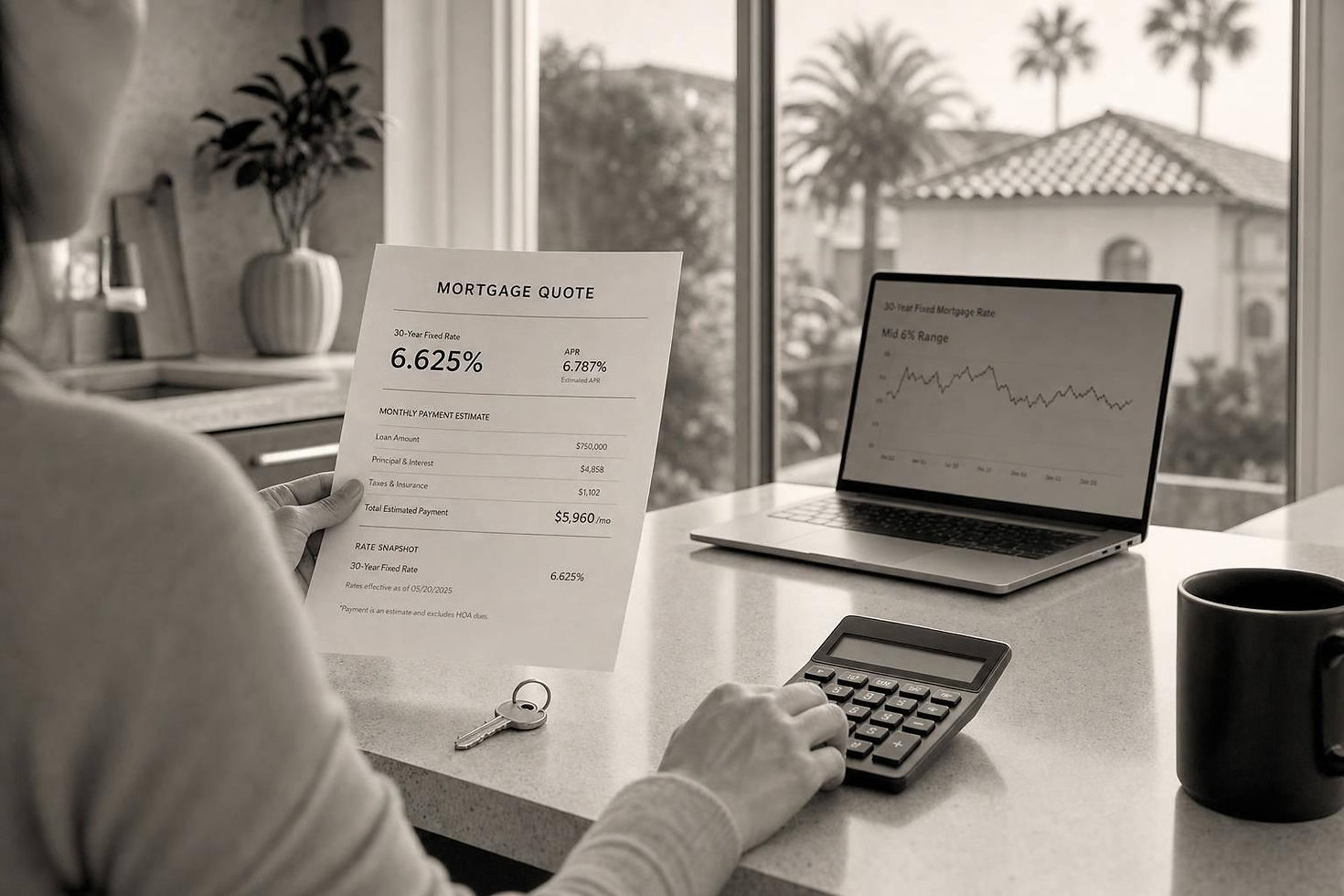
San Diego Mortgage Rates: Trends 2026

San Diego buyers are still dealing with mortgage rates in the mid-6% range, and that keeps monthly payments high. Even though some local 30-year fixed quotes have been around 6.125%, most buyers still need a large income to make the numbers work on homes priced near $1 million.
Here’s the short version:
Local top-tier 30-year fixed rates in early September 2026 were about 6.1% to 6.25%
National 30-year fixed rates were higher, at 6.71% for the week ending 9/3/2026
San Diego’s median single-family home price was about $1.099 million
Only 17% of county households could afford the median-priced home
A small rate move, like 0.25%, can change a payment by about $150 to $225 per month on many San Diego loan sizes
The 2026 high-balance conforming limit in San Diego County is $1,104,000, which matters because many buyers land near that line
Loan choice matters: conforming, high-balance, jumbo, FHA, VA, fixed-rate, and ARM options all price out differently
If I boil the article down to one point, it’s this: in San Diego, rate changes hit harder because home prices are so high. That means your credit score, down payment, debt-to-income ratio, and loan amount can change both your rate and what you can afford more than many buyers expect.
A few takeaways stand out:
If you’re buying, it makes sense to budget around about 6.5%
If rates drift closer to 6.0%, that helps, but it should be treated as upside, not the base case
Staying under the county’s high-balance conforming limit can help with pricing and loan approval
A fully underwritten preapproval gives you a much clearer picture than a basic prequalification
Sellers should remember that buyers are payment-driven, not just price-driven
San Diego Mortgage Rates 2026 Update Why They're Not Dropping
sbb-itb-7ed574e
Quick comparison
Topic | What matters now |
Current San Diego rate range | About 6.1% to 6.25% for top-tier conventional 30-year fixed |
National benchmark | 6.71% 30-year fixed |
Jumbo pricing | Often about 6.5% to 6.7% |
Main rate drivers | 10-year Treasury, inflation, mortgage bond spreads |
Buyer-level pricing factors | Credit score, down payment, DTI, loan size |
Affordability pressure | Very high due to $1M+ home prices |
Payment impact of rate moves | Even 0.25% can add hundreds per month |
Best buyer move | Stress-test the payment before making an offer |
This article gives a plain-English look at where San Diego mortgage rates stand in 2026, what’s moving them, how they change monthly payments, and what buyers and sellers should watch for through the rest of the year.
Current Mortgage Rate Levels in San Diego
Loan type, credit score, and down payment can push San Diego pricing away from the headline rate. That gap matters a lot here because many loans land near conforming limits.
As of early September 2026, well-qualified San Diego buyers were seeing roughly these top-tier quotes from local lenders:
Loan Type | Rate | APR |
Conventional 30-year fixed | 6.125% | 6.263% |
High-balance 30-year fixed | 6.125% | 6.254% |
FHA 30-year fixed | 5.750%–5.800% | Higher once MIP and fees included |
VA 30-year fixed | 5.750% | 5.818% |
Jumbo 30-year fixed | 6.500% | 6.618% |
15-year fixed (CA benchmark) | 6.250%–6.410% | - |
These are top-tier owner-occupied quotes. Actual pricing changes based on credit, down payment, loan size, and fees.[3][4][9][10][11][12][15]
San Diego quotes were still below state and national averages. California's statewide 30-year fixed rate was 6.84% on Sep. 9, 2026, and Freddie Mac's national benchmark was 6.71% for the week ending Sep. 3, 2026.[6][2] In a market this expensive, even a small shift in rate can change a buyer's monthly payment in a big way.
Jumbo loans also carry extra weight in San Diego. In 2026, jumbo rates ran about 0.125 to 0.25 points above conforming loans. For strong borrowers, that often put jumbo pricing around 6.5% to 6.7%, while the national jumbo benchmark came in at 6.728% on Sep. 8, 2026.[4][10][11][13][15][16][23]
How 2026 Rates Compare to Late 2025 and Early 2026
In 2026, rates briefly dipped below 6% before moving back into the mid-6% range.
On Feb. 26, 2026, Freddie Mac recorded a 30-year fixed rate of 5.98%, the first reading below 6% in about 3.5 years.[22] But that break didn't stick. By spring, rates had moved back above 6%. By summer, they were sitting firmly in the mid-to-upper 6% range.
The Freddie Mac weekly data shows the move pretty clearly:
Week Ending | 30-Year Fixed Rate |
Feb. 26, 2026 | 5.98% |
Mar. 26, 2026 | 6.38% |
Apr. 2, 2026 | 6.46% |
Jun. 11, 2026 | 6.52% |
Jul. 30, 2026 | 6.66% |
Aug. 6, 2026 | 6.69% |
Aug. 27, 2026 | 6.66% |
Sep. 3, 2026 | 6.71% |
Compared with late 2025, rates in 2026 are a bit lower, but the drop has been limited and uneven. For San Diego buyers, 2026 looks more like a plateau than a clear cooldown. Borrowing costs are a touch better than the highs from 2025, but still far from the low rates that showed up for a moment in February.
Since spring, the pattern has been mostly flat with a slight upward drift, not a steady drop.
Those moves tie back to inflation, Treasury yields, and borrower risk. The next section gets into that.
What Is Driving San Diego Mortgage Rates in 2026
Inflation, Fed Policy, and the 10-Year Treasury
The difference between headline mortgage rates and the rate a San Diego buyer actually gets comes down to two things: market pricing and borrower-level pricing.
The Fed matters, but the 10-year Treasury matters more. Since 1990, monthly changes in the 30-year mortgage rate have had a 0.86 correlation with the 10-year Treasury yield, compared with just 0.17 for the Fed funds rate.[35] That’s why, in 2026, a 10-year Treasury yield of about 4.3% to 4.6% has led to mortgage rates in the mid-6% range. Lenders are adding a spread of about 1.5 to 2.0 points to cover volatility and mortgage-backed securities risk.[34][11][26]
That spread hasn’t stayed high by accident. Rate swings and tighter bank balance sheets have made investors ask for more pay to hold mortgage-backed securities. When demand for MBS is strong, the spread gets smaller and rates tend to ease. When investors want more pay for uncertainty, the spread gets bigger and rates move up, even if the Fed doesn’t change anything.[25][26]
That gives you the market starting line. From there, the borrower’s file does the rest.
Credit Score, Down Payment, Debt-to-Income Ratio, and Loan Size
Actual mortgage pricing can shift a lot from one borrower to another. Credit score is one of the biggest factors.
Borrowers with FICO scores of 760 or above can often get top-tier rates in the mid-6% range on a 30-year fixed high-balance loan. In the 700–739 range, that same loan is often priced about 0.125 to 0.25 percentage points higher. In the 660–699 range, the price bump can reach 0.25 to 0.50 percentage points, which can push rates into the upper-6% to low-7% range.[1][4][28][14]
In San Diego, loan size is a big deal because home prices are so high. The 2026 high-balance conforming limit for a single-family home in San Diego County is $1,104,000.[36] Loans from about $832,751 to $1,104,000 fall into the high-balance conforming bucket and are often priced 0.125 to 0.25 percentage points above standard conforming. Loans above $1,104,000 are jumbo, and those often come with rates 0.50 to 0.75 percentage points above baseline conforming pricing.[30][11][36]
Here’s where it gets tight fast. A buyer putting 5% down on a $1,100,000 home would need a loan of about $1,045,000. That lands squarely in high-balance territory. Go a bit higher on the price, or a bit lower on the down payment, and that borrower can slip into jumbo pricing, where underwriting gets tougher.[11][4][27][28]
Debt-to-income ratio (DTI) matters too. Lenders often get stricter once DTI moves above about 43%. That can shrink a buyer’s loan choices or lead to higher rates, especially for self-employed borrowers or people with variable income.[1][4][27]
In a market like San Diego, those small pricing gaps don’t stay small for long. They show up in the monthly payment almost right away.
Why Affordability Pressure Hits Harder in San Diego
With a median home price of $1,075,000, even small rate moves can change who qualifies and who doesn’t.[29][33] At a 6.54% rate with 20% down, a buyer would need about $268,000 in annual income to qualify under standard guidelines.[29][33] Meanwhile, the county’s median household income is about $115,745, and only around 17% of San Diego County households can afford the median-priced single-family home right now.[31][29][33]
The payment math is where this hits home. On a $900,000 loan, a move of 0.25 points from 6.25% to 6.50% adds about $150 per month in principal and interest. A 0.50-point move adds about $300 per month.[11][1][4][27][28][14] On a $1,050,000 high-balance loan, a 0.25-point change can shift the payment by about $175 to $225 per month.[11][1][4][27][28][14]
That kind of swing matters a lot in places like Carmel Valley (92130) and University City (92122), where detached homes often list above $1,000,000. A small rate jump can push a household past a lender’s DTI cap. A small drop can pull them back under it.
And this isn’t just an issue in the priciest ZIP codes. In areas like Serra Mesa (92123) and Tierrasanta (92124), where mid-tier homes are around $904,483, buyers still run into the same wall: the monthly payment.[32] The list price matters, of course. But in practice, rate changes often decide what stays in reach and what slips away.
What 2026 Rates Mean for San Diego Homebuyers
Today’s rates shape two big things: your monthly payment and which loan type makes sense.
Monthly Payment Examples at Common San Diego Price Points
Here’s how payments look at some common San Diego price points. The table below uses a 6.5% 30-year fixed rate with 20% down as a simple baseline.[37]
Purchase Price | Loan Amount (20% down) | Monthly P&I (6.5%, 30-yr) | Approx. Income Needed (~28% DTI, P&I only) |
$700,000 | $560,000 | ~$3,540 | ~$152,000 |
$900,000 | $720,000 | ~$4,550 | ~$195,000 |
$1,100,000 | $880,000 | ~$5,560 | ~$238,000 |
$1,500,000 | $1,200,000 | ~$7,580 | ~$325,000 |
These figures cover principal and interest only. Property taxes, homeowners insurance, and HOA dues can push the full monthly cost much higher.[41][42] On a $1,100,000 home, total housing costs can reach $6,500 or more per month.[33][29]
That’s why many buyers don’t stop at the mortgage number. They look at the all-in payment first, then decide which loan setup fits that budget.
Fixed-Rate vs. Adjustable-Rate Options in a Mid-6% Market
Your best option comes down to two things: how long you expect to keep the home and how much payment swing you can handle.
Loan Type | Typical Rate (Mid-2026) | Payment Stability | Best Fit |
30-year fixed | ~6.5% | Locked for 30 years | Long-term owners; buyers who want certainty |
15-year fixed | ~5.9% | Locked for 15 years | Higher-income buyers; faster equity building |
5/6 or 7/6 ARM | ~5.75%–6.0% (initial) | Fixed 5–7 years, then adjusts | Buyers planning to sell or refinance within the fixed window |
On a $1,100,000 purchase with 20% down, a 30-year fixed at 6.5% costs about $400–$450 more per month in principal and interest than a 7/6 ARM starting at 5.8% during the ARM’s fixed period.[37] That gap can look tempting.
But there’s a catch. Once that fixed period ends, the ARM resets based on an index plus the lender’s margin. If rates stay high, the payment can jump fast.[37]
A 15-year fixed works differently. At around 5.9%, it can cut total interest paid by a lot and helps you build equity sooner. The tradeoff is simple: the monthly payment is higher, so qualifying can be tougher from a DTI standpoint. It tends to fit buyers who are shopping below their top budget and have enough income to handle the bigger payment.[37]
For many San Diego buyers, the 30-year fixed is still the easier path to live with. The payment stays steady, which matters when taxes, insurance, and HOA fees may already be adding hundreds of dollars each month.
Steps Buyers Can Take Before Making an Offer
A few moves before you submit an offer can change both the rate you get and whether you qualify at all.
Your credit score is one of the fastest levers to pull. Moving into the 740+ range can lower the rate offered and open up more loan choices, especially for buyers borrowing between $700,000 and $1,000,000.[37] In practical terms, that often means paying down revolving balances and fixing errors on your credit report before you apply.
It also helps to know where your loan amount sits against San Diego’s conforming limit. The 2026 high-balance conforming limit for San Diego County is $1,104,000.[43][44][45] Staying at or below that line keeps you in conforming territory, which usually means easier underwriting and better pricing than jumbo financing. For example, a buyer putting 20% down on a $1,100,000 home ends up with an $880,000 loan, which stays well inside conforming territory. At higher purchase prices, or with a much smaller down payment, that loan amount can cross the line and shift into jumbo pricing.
One more thing matters in a market like San Diego: get a fully underwritten preapproval, not a prequalification. That gives you a clearer read on whether the payment works under current lender rules and helps you act fast when the right property shows up.[38][39][40]
Those payment ranges help frame the 2026 rate outlook.
Rate Outlook for the Rest of 2026 and Key Takeaways
Baseline, Lower-Rate, and Higher-Rate Scenarios
Rates are still sitting in the mid-6% range, so the rest of 2026 will mostly come down to one thing: does inflation cool off, or does it stay sticky?
Freddie Mac’s weekly PMMS showed the 30-year fixed at 5.98% in late February and 6.71% on September 3, 2026. That’s a move of more than 0.7 percentage points in about six months.[58][2] Forecasts from Fannie Mae and the MBA put 2026 mortgage rates at about 6.4%, with the MBA a bit higher at 6.5%.[56][57]
If inflation cools faster and the Fed cuts more than expected, the 30-year fixed could drift down to about 5.7%–6.0%. If inflation stays sticky or Treasury yields keep climbing, rates could stay in the 6.5%–6.8% range or move higher.[46][47][48][51][53][54][55][8] The Federal Reserve’s July 2026 Monetary Policy Report added more context: Treasury yields rose on net, with the 10-year yield up about 35 basis points and the 2-year up about 60 basis points since the start of the year.[59]
The main things to watch are pretty simple:
Monthly CPI and PCE inflation readings
Federal Reserve meeting statements
Movements in the 10-year Treasury yield
Those three signals usually tell you where mortgage rates are headed next.
For San Diego buyers, this isn’t just about a rate on paper. It’s about the monthly payment. At San Diego price points, even a modest rate gap can mean hundreds of dollars more or less per month.[37][49][52][55]
Key Points for San Diego Buyers and Sellers
That hits harder in a market where qualifying is already tough. San Diego’s affordability gap means even small rate changes can have a big effect.[5][24] A move of just 0.3 to 0.5 percentage points can be enough to push a buyer toward a smaller home or a different neighborhood.[37][49][50][52][55]
The clearest move is to plan around the baseline, not the best-case scenario. Stress-test your budget at 6.5% or a little above that. That gives you a more grounded floor. If rates ease toward 6.0%, great - that’s upside.
Buyers who’ve already improved their credit score, lowered their debt-to-income ratio, and locked in a fully underwritten preapproval will be in a stronger spot when the market shifts. Sellers, especially in coastal and higher-price neighborhoods, need to pay close attention to pricing and presentation because buyers are extra rate-sensitive when affordability is stretched. Local guidance can help both sides line up their plan with neighborhood demand, inventory, and current rate conditions.
FAQs
Should I lock my rate now or wait?
It depends more on your financial stability than on trying to predict rate moves. Lower rates can shrink your monthly payment, but they can also bring more buyers into the market and push home prices up, which can wipe out those savings.
If you lock now, ask your lender about a float-down option. If rates drop later, refinancing may still be on the table.
How much income do I need to buy in San Diego?
To buy a median-priced home in San Diego, a household usually needs an income of about $258,926.
That number comes down to what lenders will approve. In most cases, they want to see a debt-to-income ratio of 36% or less. That includes your mortgage, homeowners insurance, property taxes, HOA fees, and other monthly debts.
Of course, the math can shift depending on the neighborhood and the type of property you're looking at. A condo with HOA fees is a different story than a single-family home. That’s where the Richard Elias Team can help by estimating your purchasing power with more precision.
What loan type makes the most sense in 2026?
The best loan in 2026 comes down to your finances and what you qualify for. There isn’t one pick that fits everyone.
Conventional loans are often a strong choice for buyers with credit scores of 680 or higher. They tend to come with competitive pricing, and their mortgage insurance can be removed once you reach 80% loan-to-value.
For veterans, VA loans often stand out because they may offer lower rates and no down payment. FHA loans can make home buying easier for people with lower credit scores, while USDA loans are built for homes in rural areas.


Comments